
You will run across classic Great Plains country from the Missouri–Kansas border all the way into the high plains of southeastern Colorado, passing working farm towns, wide open prairie, and slowly rising ground with the Rockies far ahead. The course starts in lower, more humid cropland in eastern Kansas and gradually climbs onto the drier High Plains toward Colorado, so the air feels drier and the land feels bigger as you go. As you move west, you will notice the change from greener fields and scattered trees to shortgrass prairie, bigger skies, and fewer windbreaks.
Much of what you see will be large crop fields of corn, wheat, and other grains, along with grain elevators and small farmsteads that mark the small towns of central and western Kansas. Long, flat, or gently rolling stretches give you clear views of hay bales, huge irrigation circles, and distant water towers that become your targets on the horizon. The miles feel honest and open, with very little to block your view or your thoughts.
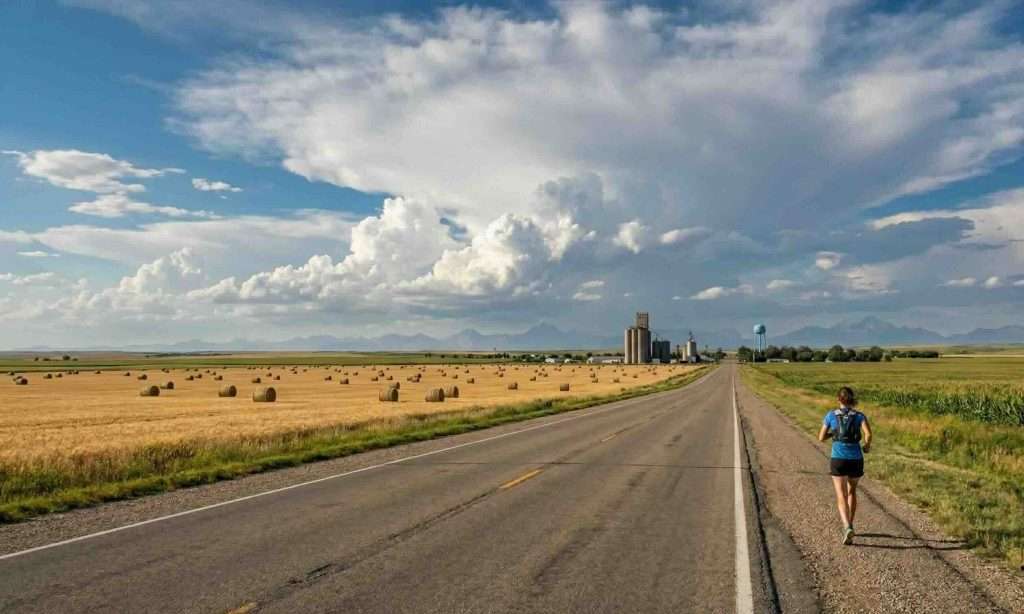
West of central Kansas and into Colorado, you reach the higher High Plains, a mostly treeless grassland that rises toward about 3,000 to 4,000 feet as you get closer to the Rockies, and the sky starts to feel huge and dramatic. This part of the route is known for big weather and big sky, with tall cloud layers, fast-moving storm fronts, and long views across shortgrass prairie and river cut valleys. You will often be able to see weather building and moving from a long way off.
The route runs along the same general corridor that past travelers, ranchers, and later highways used to push west toward Colorado and the mountains, so you are literally running in the path of earlier westbound journeys. Many of the small towns you pass are built around grain elevators, feedlots, and rail lines, giving you a close look at real working farm communities. These towns break up the open stretches and give you regular human landmarks in the middle of all that space.
Near the western end of the route, the land tilts up a little more and dries out, marking your entry into Colorado’s Eastern Plains, the last stretch of the Great Plains before the mountains. On clear days near the Colorado side, you can see the Front Range in the distance ahead of you, a constant reminder of how far you have come and where this run is taking you.